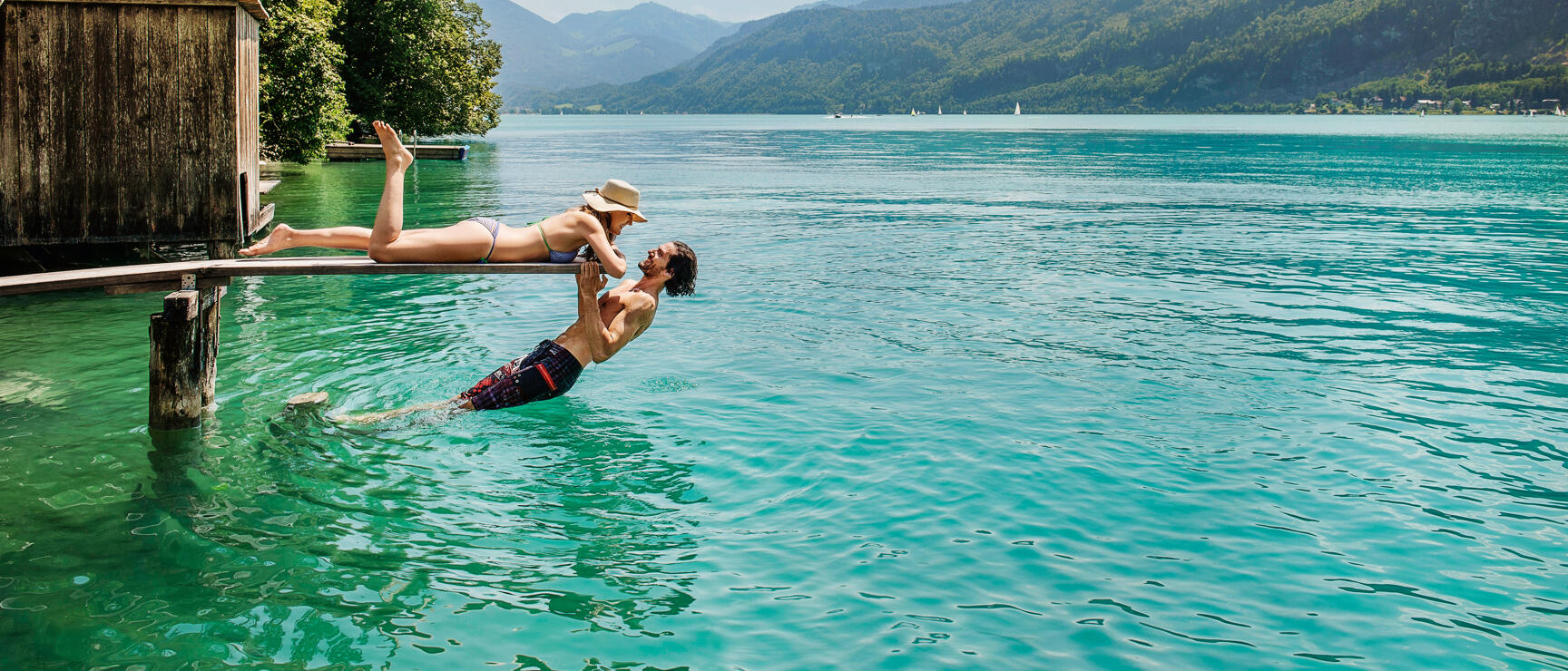
Lake Wolfgangsee in Salzkammergut
Bathing and hiking, views from a boat and the Schafberg onto the lake

As if it were resting in itself - completely un-agitated and aware of its beauty: Nestled between forests, mountain landscapes, and small villages.

Lake Wolfgangsee is shared by two provinces: SalzburgerLand and Upper Austria. In the Salzkammergut, it is one of those swimming lakes you do not simply visit, but truly experience. It is the landscape around the lake, the many ways to enjoy the outdoors, and the way of life of the people who call this place home: relaxed, welcoming and guided by a fine sense of what feels good. They call it 'Alles gschmah' - when everything feels just right and follows its own rhythm.

Originally, the lake was known as 'Abersee', first mentioned in records around 800. Around 500 years later, it became 'Wolfgangsee', named after Saint Wolfgang, who turned the village into an important place of pilgrimage in the Middle Ages. Today, the lake reveals many different shades of colour, created by the interplay of organisms in the water and fine limestone particles - from light to deep tones of blue and green.

Lake Wolfgangsee
LocationSalzkammergut, SalzburgerLand and Upper Austria
Metres above sea level538 m
Depth114 m
Surface12,4 km²
Lenght10,3 km
Width2 km
Shore Lenght27 km
Temperatureup to 24° C in summer

Discover Lake Wolfgangsee

Bathing tips for Lake Wolfgangsee

Top highlights on Lake Wolfgangsee

The most beautiful villages at Lake Wolfgangsee

Top Restaurants

Wining and dining at Lake Wolfgangsee

Around Wolfgangsee, in St. Wolfgang, St. Gilgen and Strobl, the culinary range extends from award-winning fine dining to lakeside restaurants. Meals are served on terraces overlooking the water or in calm, elegant dining rooms. Menus feature fish dishes, seasonal tasting menus and à la carte options.

Events around Lake Wolfgangsee

5 things to know about Lake Wolfgangsee

Film 'Im weissen Rössl'

The operetta Im weissen Rössl and its film adaptation in the 1960s turned the hotel of the same name into a symbol of summer retreats by the lake. To this day, it remains one of the region's most popular excursion destinations.

Postalm

Around 12 kilometres above Strobl lies the Postalm, Austria's largest connected alpine pasture area. The high plateau is crossed by walking trails that wind through meadows and alpine pastures.

Nostalgic boat trips

During the summer months, the historic paddle steamer Kaiser Franz Josef I. cruises across Wolfgangsee, offering a calm and leisurely journey on the water.

Ochsenkreuz

On a small island near Falkenstein in St. Gilgen stands the Ochsenkreuz, a historic wayside shrine linked to the legend of a butcher and his ox. It can only be seen from the water.

Saint Wolfgang

In the Middle Ages, Saint Wolfgang made the region an important pilgrimage destination. At Falkenstein, the legend of the 'miracle spring' tells of the building of a small church on Lake Abersee and of miraculous healings.

Special Accommodation at Lake Wolfgangsee

Since 1964

Climatic health resort St. Wolfgang

Since 1964, St. Wolfgang has officially held the title of a climatic health resort. Located on the southern slopes of the Northern Alps, the local climate is shaped by sunshine, layers of high-altitude fog and the proximity to Wolfgangsee. The lake helps regulate temperatures, while air currents create noticeable changes throughout the day. These climatic conditions are regularly monitored and form the basis for the resort's official designation.

FAQ

Lake Wolfgangsee is one of Austria's most famous lakes, located in the Salzkammergut region, spanning the borders of Salzburg and Upper Austria. The larger part lies in Salzburg, while the northern part belongs to Upper Austria. The municipalities of St. Gilgen, Strobl, and St. Wolfgang surround the lake.

Geographically, Lake Wolfgangsee is situated in an idyllic alpine landscape, nestled between the Schafberg to the west and the Zwölferhorn to the east – two prominent mountains popular with families for outings. The views of Lake Wolfgangsee and the surrounding region are stunning.

In summer, Wolfgangsee reaches water temperatures of up to 24°C. The main swimming season is usually between July and August, when the water is at its warmest.

Lake Wolfgangsee combines alpine scenery with a wide range of activities on and around the water. Highlights include rides on the Schafberg Railway, boat trips between the lakeside villages, and swimming areas along the shore.

Wolfgangsee can be reached by train via Salzburg or Attnang-Puchheim stations. From there, bus connections continue to St. Gilgen, Strobl and St. Wolfgang. Within the region, buses and boats connect the different lakeside villages.

Among the best-known attractions are the pilgrimage church in St. Wolfgang, the Schafberg Railway and the Wolfgangsee boat service.

Wolfgangsee, the largest and deepest lake in SalzburgerLand, is also a popular destination for sailing.

Walking trails lead through the surrounding mountains, cycling routes circle the lake, and lakeside beaches invite visitors into the water during summer.

The original name of Lake Wolfgangsee was "Abersee," first mentioned in records around 800 AD. Five hundred years later, it was renamed "Wolfgangsee" after Saint Wolfgang, who turned the area into a medieval pilgrimage site.

Lake Wolfgangsee is renowned for several reasons:

  1. Natural Beauty: The lake is known for its stunning natural beauty. Surrounded by high mountains like the Schafberg and the Zwölferhorn, it offers picturesque views and rich natural surroundings.

  2. Recreational Activities: There are many recreational opportunities at Lake Wolfgangsee, including swimming, boating, hiking, and climbing in the summer, and winter sports in the surrounding areas.

  3. History and Culture: The region around Lake Wolfgangsee has a rich history and culture. The towns of St. Wolfgang, St. Gilgen, and Strobl have historic centres with traditional architecture and are known for their cultural events.

  4. Musical Heritage: St. Gilgen is the birthplace of Mozart's mother and the home of his sister Nannerl. The idyllic landscape around Lake Wolfgangsee also inspired composer Franz Lehár, who lived and worked nearby.

  5. Film and Television: Lake Wolfgangsee has been the location for numerous films and TV series. It is especially famous for the operetta "The White Horse Inn" ("Im Weißen Rössl"), composed by Ralph Benatzky in 1930. The operetta is set in the famous hotel of the same name on Lake Wolfgangsee and was later adapted into several films.

You might also like

Discover the Best of Austria

Sign up for our newsletter and enjoy exclusive access to:

  • Insider tips for your next Austrian holiday

  • Delicious recipes

  • Must-see events and cultural highlights

  • Special travel deals and offers